See creative performance clearly

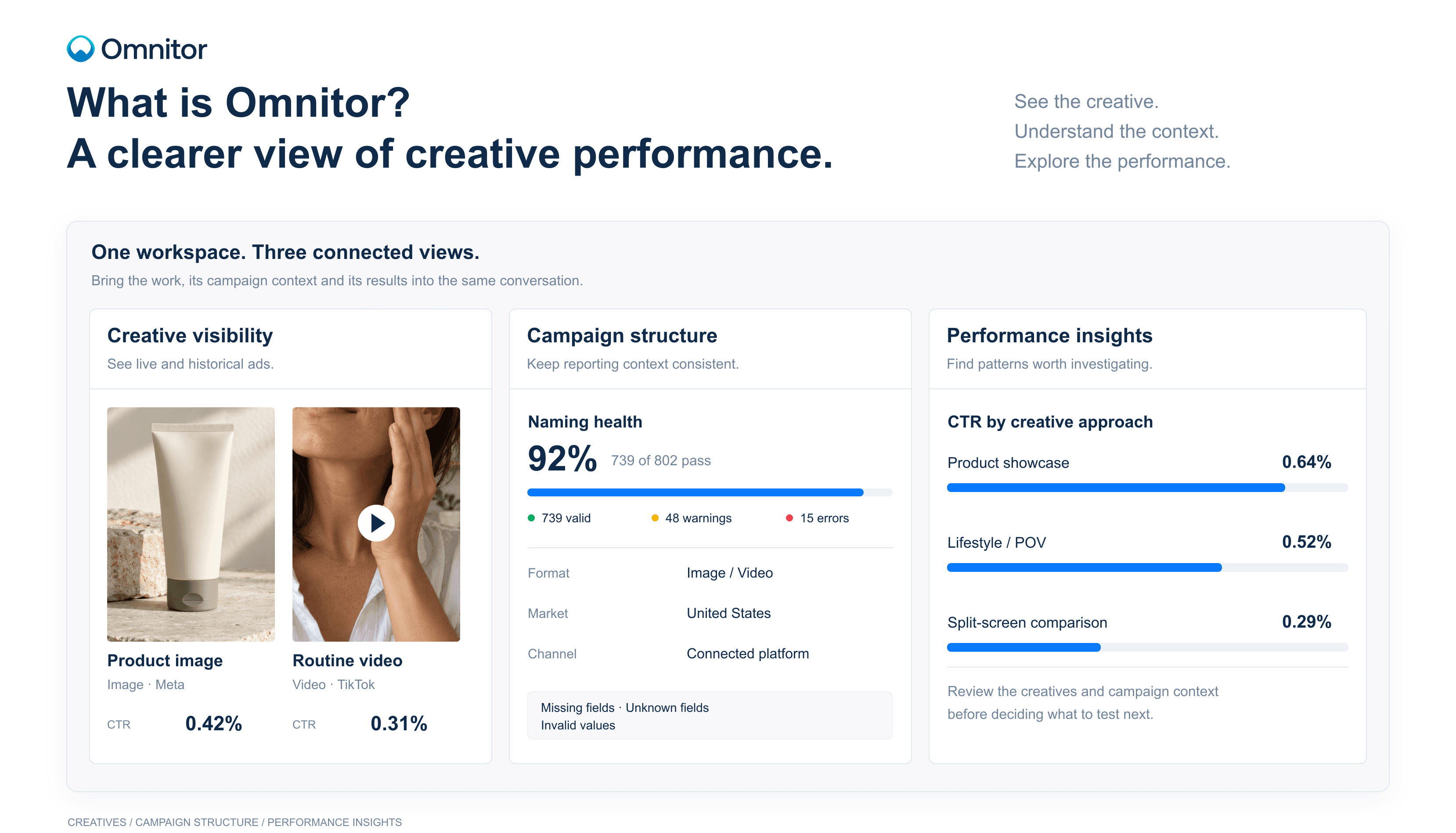
You open a campaign report and find an ad with a strong click-through rate. The numbers tell you it performed well. To understand the creative behind those numbers, you open another tab, search for the ad, and try to piece together its campaign context.
What did it show? Which message did it use? Was it a video or an image? Have you run something similar before?
These are everyday questions for marketing teams. Answering them often takes more work than it should.
Omnitor brings creatives, campaign structure, and performance data into one workspace. It helps teams see what is running, understand how their ads differ, and use what they learn to plan the next campaign.
Start with the ad itself
Campaign reports usually start with rows of names and numbers. Creative teams tend to start with the work: an image, a video, a product shot, a headline.
Both views matter. Looking at them together makes a report much more useful.
Omnitor gives teams a visual overview of live and historical creatives across connected channels, with performance information alongside the ads. You can review the actual creative while looking at its results, rather than trying to recognise it from a campaign name.
That changes how a team can approach a review. Instead of passing around screenshots and asking which ad belongs to which result, everyone has a shared place to look.
Historical creatives matter here, too. A campaign may have ended, but the work can still inform a new brief. Being able to find and compare past ads helps teams keep those lessons accessible.
Give campaign data a consistent structure
A visual overview is a useful starting point. Meaningful comparisons also need consistent campaign information.
Consider a team reviewing product videos across several markets. One market uses “Video” in its naming convention. Another uses “VID.” A third leaves the format out entirely. Before anyone can compare results, someone has to work out which ads belong in the report.
Small inconsistencies create a lot of manual work as campaigns grow.
Omnitor’s taxonomy and naming tools help teams define a consistent structure for campaign data. Validation surfaces issues such as missing required fields, unknown fields, and invalid values, so teams can review the problems affecting their reporting.
The purpose is practical: make it easier to group the right ads, compare them on a consistent basis, and understand what a report includes.
Structure also gives creative results context. An ad’s format, market, channel, and campaign details can all matter when interpreting its performance. Keeping that information organised helps teams ask more precise questions.
Look beyond individual winners
Finding a strong ad is useful. Finding a pattern across several ads can give a team something more specific to investigate.
Do product demonstrations tend to have a higher click-through rate? How do image ads compare with video? Are certain calls to action associated with stronger results? Does a pattern appear across channels, or only in one?
Omnitor’s creative insights let teams explore performance alongside attributes such as subjects, products, dominant colors, mood, style, and calls to action.
These attributes provide another way to organise and compare the work. Alongside campaign-level reporting, teams can look at the characteristics of the creatives themselves.
A finding might show that ads featuring people outdoors have a higher CTR within a selected group. That gives the team a direction to explore. It does not establish that the outdoor setting caused the difference. Audience, placement, spend, and other campaign conditions may also have played a part.
The value is in making those patterns easier to see and investigate.
Bring creative and performance teams into the same conversation
Creative and performance teams often approach a campaign from different starting points.
A designer may want to understand which visual treatments are worth developing. A media buyer may be focused on cost and response. A marketing lead may need to decide where the team should put its next round of production effort.
Those questions are connected.
Omnitor brings the creative, its campaign context, and its results together so teams can discuss them from a shared view. A performance review can include the actual ads. A creative discussion can include the numbers. A new brief can reference previous work and the findings behind a proposed test.
This gives feedback more substance. “We need more ads like this” can become a discussion about which elements to retain, which to change, and what the team wants to learn.
Turn a finding into a test
Suppose a team notices that product demonstration videos have a higher CTR than product-only images in a report.
There are several possible explanations. The format may matter. So might the audience, the offer, or the way the product is presented. The next step is to review the creatives and their campaign context before deciding what to test.
The team could then create two versions of the same concept: one showing the product in use and one showing the product on its own. Keeping the audience, offer, and placement as consistent as practical would make the comparison more informative.
Omnitor supports the work around that decision: finding the relevant creatives, checking their structure, comparing performance, and identifying the pattern that prompted the test.
The team still applies its judgment. The difference is that the discussion starts with information everyone can review.
Where Omnitor fits
Omnitor is built for teams that need to understand creative performance across campaigns and connected media platforms.
It brings together three parts of that work:
Creative visibility: see and revisit the ads your team runs.
Campaign structure: keep naming and taxonomy consistent enough to support useful reporting.
Performance insights: compare results and explore patterns across creative attributes.
Together, these help teams move from reviewing what happened to deciding what deserves another look, and what to test next.
Explore Omnitor to see how creatives, campaign data, and performance come together in one workspace.